What are the 16 enzymes in Physician's Choice Digestive Enzymes?
Sixteen, named one by one in an 85 mg blend, from bromelain to invertase. Physician's Choice describes the formula in one line: "Digestive Enzymes is a broad-spectrum blend designed to be taken with meals to help break down proteins, fats, dairy, and carbohydrates."‡1,2
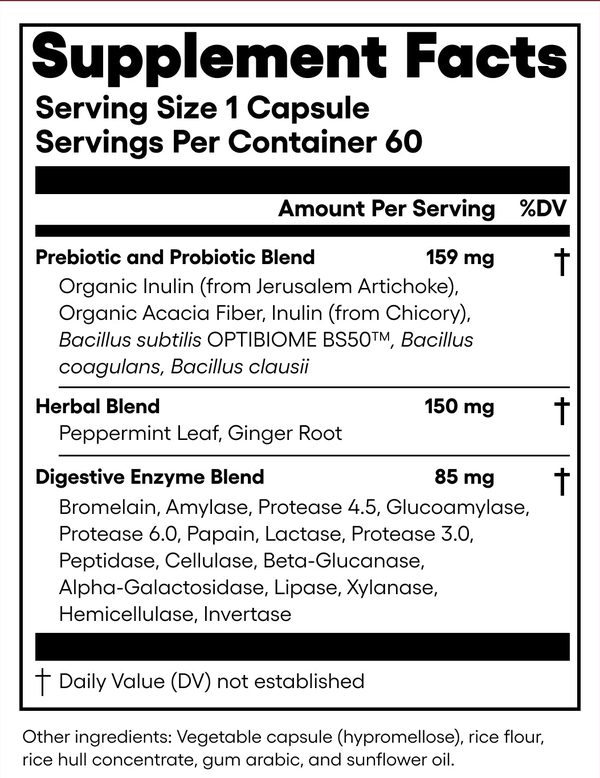
Cleveland Clinic sorts the main enzyme types by what they act on: amylase digests starches, protease digests proteins, lipase digests fats, and lactase breaks down lactose.4 All four are on this label. Protease appears three times, as protease 4.5, 6.0 and 3.0, and the blend adds bromelain from pineapple and papain from papaya.
The order on the panel follows a rule. FDA requires the ingredients inside a blend to be declared "in descending order of predominance by weight."7 This panel lists bromelain first and invertase last, and it gives no weight for any single enzyme.1
What is in the prebiotic and probiotic blend?
Three fibers and three Bacillus species, 159 mg in all. The panel lists organic inulin from Jerusalem artichoke, organic acacia fiber and inulin from chicory, then Bacillus subtilis OPTIBIOME BS50™, Bacillus coagulans and Bacillus clausii.1 Bacillus is one of the genera NIH lists as common in probiotic products.5
The count is the line to watch. NIH notes that a CFU count shows how many active microorganisms a product holds more accurately than their weight.6 This panel prints none, and another Physician's Choice product image does, so the record holds the count until Physician's Choice confirms which is right. The three species are entered as printed in the strain register (PC-REC-001).
Are the peppermint and ginger in Digestive Enzymes organic?
No. The panel lists the 150 mg herbal blend as peppermint leaf and ginger root, without the word organic, and Physician's Choice confirmed on Oct 28, 2026 that neither herb is organic.1,2 Some earlier Physician's Choice product copy called them organic; Physician's Choice confirmed the label is right.
The organic ingredients on this label sit in the other blend: the inulin from Jerusalem artichoke and the acacia fiber. The chicory inulin is printed without the word.1
Who is Digestive Enzymes made for?
For meals. Physician's Choice's guidance is to match the enzyme to the food: "For occasional gas and bloating after meals, choose a digestive enzyme that helps break down the food components that may be causing discomfort: lactase for lactose in dairy, or alpha-galactosidase for certain carbohydrates in foods like beans, lentils, broccoli, and cabbage."‡2 This label carries both of those enzymes, lactase and alpha-galactosidase, inside the 85 mg blend, alongside 14 other enzymes.1
It is not one of the products Physician's Choice recommends for children: Physician's Choice names its Kids line as the only ones it recommends for children under 18, in the line quoted in the clinician table below.2
Can you take Digestive Enzymes with 60 Billion Probiotic?
Yes. Physician's Choice sells the two together, with these directions: 60 Billion Probiotic, 1 capsule daily; Digestive Enzymes, 1 capsule with your biggest meal.2 The two share no strain: Digestive Enzymes lists three Bacillus species, and none of the ten species on the 60 Billion Probiotic panel is a Bacillus.
Physician's Choice puts what each part does in its own words:
Probiotics help support digestive comfort by addressing bloating, burping, and occasional gas; enzymes help break down carbohydrates and dairy; and a postbiotic helps support a healthy gut lining.‡
The 60 Billion Probiotic label is reviewed line by line in PC-REC-008.
Is Physician's Choice Digestive Enzymes good? What a records review can show
A record shows what is printed and who stands behind each line; it cannot show how the capsule works for you. Cleveland Clinic notes that the body makes its own enzymes in three places: the stomach, the small intestine and the pancreas.4 No study of the finished capsule is entered here.
Here is what this record can confirm for Digestive Enzymes: 16 named enzymes and their blend weight, three named Bacillus species, the herbs and their status, the directions, the shelf life and a per-lot testing statement. Here is what it cannot: a CFU count, activity units, or the weight of any single enzyme. The name is not a verdict either. In Physician's Choice's words: "Physician’s Choice is our brand name, not a claim that doctors recommend or endorse our products."
What does the record not show?
Whatever the label and Physician's Choice do not state, or state two ways. The table lists each gap and what the record holds in its place.
| Not shown | Held instead | Status |
|---|---|---|
| A CFU count for the three Bacillus species | Nothing yet: two Physician's Choice sources differ. | Held |
| Activity units for each enzyme | The blend weight: 85 mg. | Not on the label |
| The weight of each enzyme, fiber or herb | The three blend totals: 85 mg, 159 mg and 150 mg. | Not on the label |
| The "Formulated without" list | The facility line, printed apart. | Held |
| A study of the finished capsule | Nothing. None is entered. | Not entered |
| Star ratings, review counts, customer quotes, prices | Nothing. A label prints none of them. | Left out |
Where to read the Digestive Enzymes label in full
Digestive Enzymes is a Physician's Choice product, and Physician's Choice publishes this site, so this record sets out the label and Physician's Choice's answers and goes no further. The full panel, the directions and the testing program are each on a Physician's Choice page.
When a clinician should be involved
| Situation | What to do |
|---|---|
| Gas, bloating or pain after most meals, week after week | See a clinician to find the cause; a label review cannot. |
| Severe belly pain, vomiting, or black or bloody stools | Get medical care now, before any supplement. |
| Pregnancy, breastfeeding, serious illness or a weakened immune system | Physician's Choice: "If you are pregnant or breastfeeding, are seriously ill, or have a weakened immune system, consult your healthcare provider before taking a probiotic or any other dietary supplement." |
| Known allergies | Physician's Choice: "If you have known allergies, review the product’s ingredient list and allergen information and consult your healthcare provider before purchasing or using it. Most of our products are formulated without the top 9 common allergens, but ingredients vary by product." |
| A child under 18 | Physician's Choice: "Our Kids line includes a Kids Chewable Probiotic, Fiber Gummies, and a Probiotic + Fiber Powder. These are the only Physician’s Choice products we recommend for children under 18, and each should be used according to its labeled age range and directions. Always consult your child’s pediatrician or healthcare provider before starting a new supplement routine." |
| An adverse event after taking it | Physician's Choice: "If you experience an adverse event, stop using the product and contact your healthcare provider immediately. Please also notify us at support@physicianschoice.com or 1-877-395-2707." |
The review in sum
The Digestive Enzymes record shows a 1-capsule serving with 16 enzymes in an 85 mg blend, a 159 mg prebiotic and probiotic blend with three Bacillus species, a 150 mg herbal blend of peppermint leaf and ginger root that is not organic, meal-time directions, a 2-year shelf life and a per-lot testing statement. It does not show a CFU count, enzyme activity units, a study of the finished capsule, or any rating.
Record provenance
| Part | Source |
|---|---|
| The question | "Physician's Choice Digestive Enzymes review", with the follow-ups people ask next: whether it is good, what the ingredients are, whether the herbs are organic, and how it pairs with a probiotic. |
| Label lines | The Supplement Facts image (label version 3.7.0) on physicianschoice.com, read on Nov 9, 2026, and the product page lines as held in the Physician's Choice fact base, checked line by line against 8 confirmed entries. |
| Maker's wording | Physician's Choice's answer on the herbs and its pairing line, Oct 28, 2026; and its meal, safety, testing and brand name lines, Oct 8, 2026. |
| Context | Cleveland Clinic on digestive enzymes, NIH's two probiotic fact sheets and FDA's labeling rule for supplements, read on Nov 9, 2026. |
| Left out | A CFU count, the claim text printed beside the panel, star ratings, review counts, customer quotes, prices and time to results. Lines entered later appear in the changelog. |
Questions about Digestive Enzymes
Is Physician's Choice Digestive Enzymes good?
This record gives no verdict. It shows 16 named enzymes in an 85 mg blend, a 159 mg prebiotic and probiotic blend with three Bacillus species, a 150 mg herbal blend, meal-time directions and a per-lot testing statement. It does not show a CFU count, enzyme activity units or a study of the finished capsule.
What is in Physician's Choice Digestive Enzymes?
Three blends per capsule: 85 mg of 16 enzymes, from bromelain to invertase, including lactase and alpha-galactosidase; 159 mg of inulin, acacia fiber and three Bacillus species; and 150 mg of peppermint leaf and ginger root. The capsule is hypromellose, with rice flour, rice hull concentrate, gum arabic and sunflower oil.
Are the peppermint and ginger in Physician's Choice Digestive Enzymes organic?
No. The label lists peppermint leaf and ginger root without the word organic, and Physician's Choice confirmed on Oct 28, 2026 that neither herb is organic. The organic ingredients on this label are the inulin from Jerusalem artichoke and the acacia fiber; the chicory inulin is printed without the word.
How many Physician's Choice Digestive Enzymes a day?
One capsule with your largest meal, per the product page. Some people take one more with a heavy meal, and most stop at 2 a day. Taken with 60 Billion Probiotic, the directions are 1 probiotic capsule daily and 1 enzyme capsule with your biggest meal.
Does Physician's Choice Digestive Enzymes have side effects?
Enzyme supplements can bring constipation, nausea, stomach cramps or diarrhea for some people, according to Cleveland Clinic's list. Physician's Choice notes: "Our 60 Billion Probiotic and Digestive Enzymes contain inulin, and our Fiber Gummies contain chicory root fiber; gut bacteria break down fibers like these, which can cause gas."
Where are the Physician's Choice Digestive Enzymes reviews?
Not here: this record carries no star ratings, review counts or customer quotes, because none of them is a label fact. Customer reviews sit on the product page and on retailer sites. What this record holds instead is every label line, dated, with its source, and the lines on hold marked.
Sources
- Physician's Choice: Digestive Enzymes product page and labelSupplement Facts image (label version 3.7.0), read Nov 9, 2026; directions, shelf life and testing lines as held in the Physician's Choice fact base.
- Physician's Choice: answers and approved wording for this recordHerbal blend answer of Oct 28, 2026; the meal and pairing lines of Oct 8 and Oct 28, 2026; the safety, testing and brand name lines of Oct 8, 2026.
- Physician's Choice: Is Physician's Choice third-party tested?How every lot is tested.
- Cleveland Clinic: Digestive Enzymes 101: Why They Are ImportantHealth Essentials, published Sept 5, 2025. What the main enzyme types digest, and side effects of enzyme supplements.
- NIH Office of Dietary Supplements: Probiotics, Fact Sheet for Health ProfessionalsOpened Nov 9, 2026 through a text reader (direct fetch blocked). The genera common in probiotic products.
- NIH Office of Dietary Supplements: Probiotics, Fact Sheet for ConsumersOpened Nov 9, 2026 through a text reader (direct fetch blocked). Why a CFU count matters on a probiotic label.
- 21 CFR 101.36, Nutrition labeling of dietary supplementsThe order of ingredients inside a blend on a Supplement Facts panel. eCFR, current as of Nov 5, 2026.